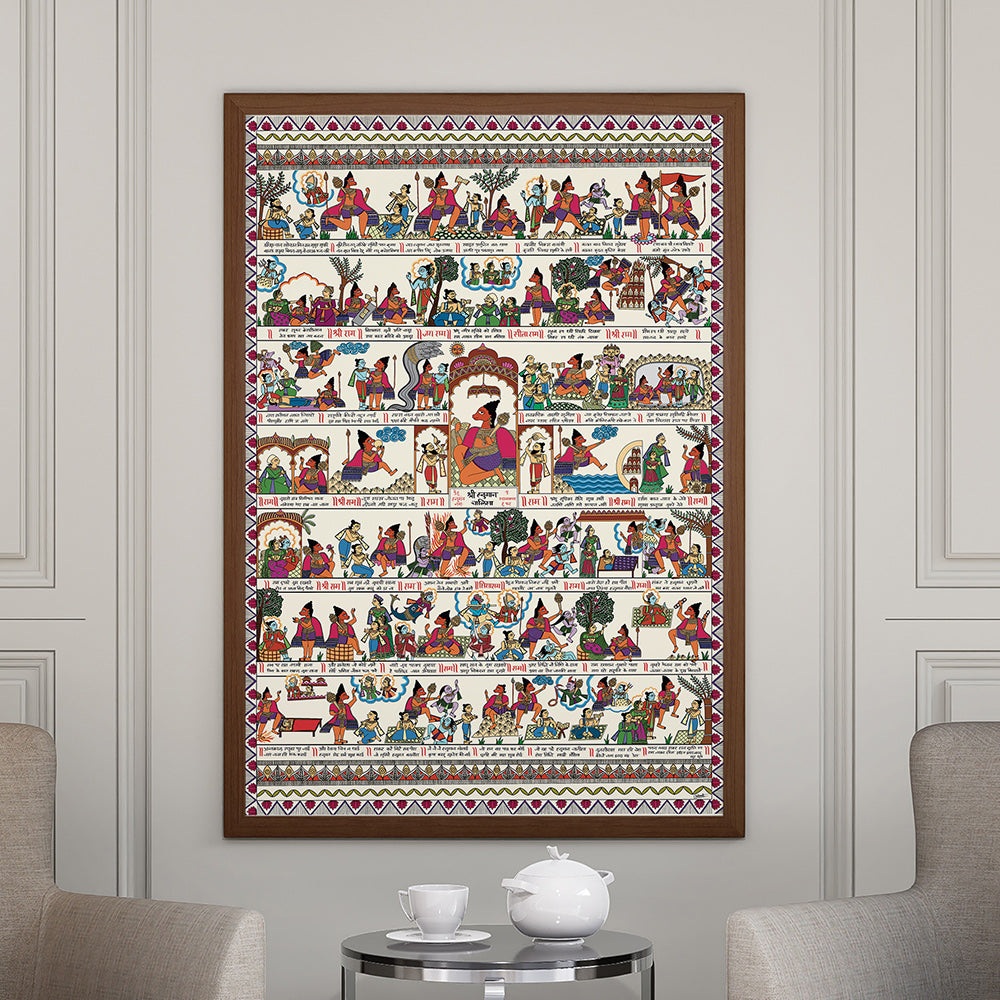


This artwork was created as an act of devotion, not decoration.
Rooted in the ancient Madhubani tradition, this Hanuman Chalisa painting brings together sacred text, disciplined geometry, and spiritual storytelling. Every section of the composition is thoughtfully arranged to visually hold the power of the Chalisa — verse by verse — transforming sound and meaning into form.
The process began with silent reading and contemplation of the Hanuman Chalisa, allowing its rhythm, strength, and protection to guide the structure of the artwork. Rather than illustrating scenes randomly, the artist followed a meditative approach — balancing symmetry, repetition, and symbolic motifs that represent courage, surrender, service, and divine protection.
Each line was hand-drawn and painted on canvas paper with patience and restraint. There was no rush. Every stroke was placed with awareness, honoring the sanctity of the text itself. The visible handwork, natural variations, and layered detailing are not imperfections — they are proof of human presence, discipline, and shraddha.
This painting is meant to be lived with. Over time, it becomes part of the space it inhabits — absorbing prayers, silence, and intention. It is created for homes and places where faith is practiced daily, not displayed occasionally.
More than an artwork, this is a visual sadhana — a reminder of strength in moments of fear, focus in moments of chaos, and devotion in everyday life.